








Introduction
Various types of codes and classifications have long been used to identify products. Currently, NATO product codification, product coding using catalog (reference) numbers, barcodes, industry indices (e.g., in defense), etc., are used. Special codes and classifications are also increasingly used in the scope of services and production activities. However, there is no field that integrates knowledge from the areas of commodity science, economics, and statistics regarding the coding of products and services (products).
The increasing number of computer programs related to product identification, the availability of the Internet, and the needs of global product data exchange are the main factors behind the emergence of new systems for coding products and their features, as well as for labeling and classification. Product codification would enable the standardization and organization of knowledge in the field of coding, classification, identification, and labeling of products. Its research objective should be all aspects of activity in this area.
1. Product coding as a scientific field
The rapid development of the IT (informatics technologies) industry and the Internet has given us easy access to many solutions for IT, search, classification, and identification systems. The excess of information causes a sense of chaos and a lack of standards among less experienced users of these systems.
The purpose of this article is to present and organize basic terms and elements of knowledge in the field of product coding. Several years of teaching and research activity in the field of NATO product codification, classification systems, index systems, and automatic identification prompted the author to formulate the concept of an interdisciplinary scientific and research subdiscipline – product coding.
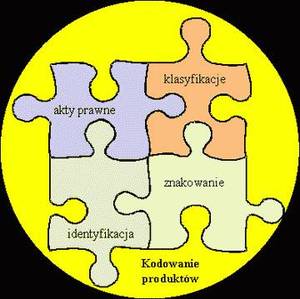
Fig. 1. Main areas of interest in product coding
Product coding is an interdisciplinary field, and its basic sources of knowledge are economics, commodity science, statistics, logistics, computer science, and law. However, it often draws on other fields of knowledge, e.g., ecology, qualitology (the science of quality). Product coding is part of object coding, which can include material goods produced by humans, natural goods, features, ideas, etc. – everything that humans classify and mark with special codes for better identification, automation, and better understanding (e.g., objects of nature – celestial bodies, flying objects in NATO, etc., have special codes and classifications).
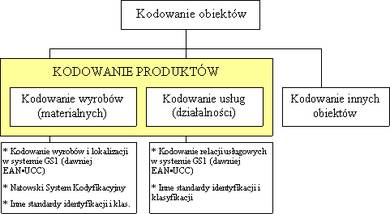
Fig. 2. Division of object coding
The subject of product coding includes systems of: coding, classification, indices, marking, and identification (including automatic identification systems) as well as legal documents regarding product coding. The term used for a similar scope of activity is often referred to in English-language literature as labeling. However, labeling only deals with issues related to techniques and technologies of product labels.
Coding systems (for products) are used to assign a unique code to a product for its identification, as well as for collecting and processing data in: trade, services, logistics, and other areas of social life. A product code can be presented in a human-readable form and/or in a machine-readable form (barcode).
Classification systems are tools for dividing various populations into smaller groups in order to better understand reality and make various types of comparisons (e.g., in economic statistics). Classification systems can take a descriptive or descriptive-coding form. In product coding (goods and services), classification systems enable initial identification or – with a high degree of detail – precise (for specific purposes) identification of a service (activity) or products.