








The article participated in the 3rd edition of the “Piórem Logistyka” Competition.
V. Transport and the concept of social and green marketing
In the 21st century, enterprises will be held responsible for sewage, packaging materials, waste management, noise, accidents, and other residues resulting from their production, transport, and marketing activities. Society, as a collective, is interested in long-term prosperity and living in a friendly, non-burdensome environment and an unpolluted natural environment. Products and services produced by enterprises must not poison or increase waste problems. Modern company strategies increasingly emphasize taking into account the interests of society and the environment. This stems from the adoption of the so-called social marketing concept. This concept assumes the balancing of three aspects of marketing policy, i.e., company profits, consumer desires, and societal interests (Fig. 1). A fundamental issue is the recognition that marketing is aware of environmental protection problems and is part of an overall environmental management system.
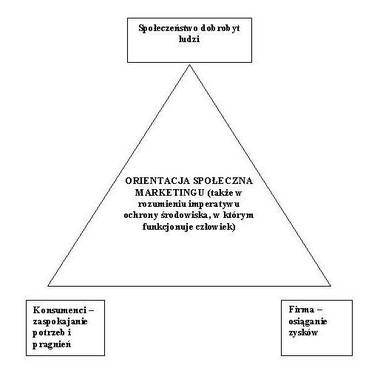
Fig. 1. Social orientation of marketing in the context of the natural environment. Source: Ph. Kotler, G. Armstrong, J. Saunders, V. Wong, Marketing. European Edition, PWE, Warsaw 2002, p. 54.
As stated by Ph. Kotler [5], the application of green marketing requires enterprises to, among other things: – comprehensively assess the company’s current activities in the field of environmental protection, – engage in deeply committed monitoring, auditing, recording, and measuring the improvement of these activities, – develop a realistic environmental policy, – invest in staff education and training, research, and technologies related to environmental protection, – create coalitions and bridges connecting diverse interests, – more closely align with marketing values, consisting of selling benefits instead of products and maintaining the value of the company, not just the product itself, – implement programs for training and supporting consumers with the intention of increasing their responsibility for the natural environment.
Summary
The European Union is constantly looking for new solutions that allow for the creation of strong economic growth while maintaining an efficient transport system, simultaneously enabling the full realization of benefits in the internal market. These solutions aim at the successive reduction of the role of road transport and the promotion of ecological means of transport. The development of logistics, building supply chains, or networks based, where possible, on rail or water transport will undoubtedly be of great importance for the protection of the natural environment.